India’s Solar Industry Is Entering a New Compliance Era
India’s renewable energy ambitions are no longer defined solely by installed capacity. As the country accelerates its transition towards a digitally connected power ecosystem, the conversation has shifted from generating energy to managing it intelligently.
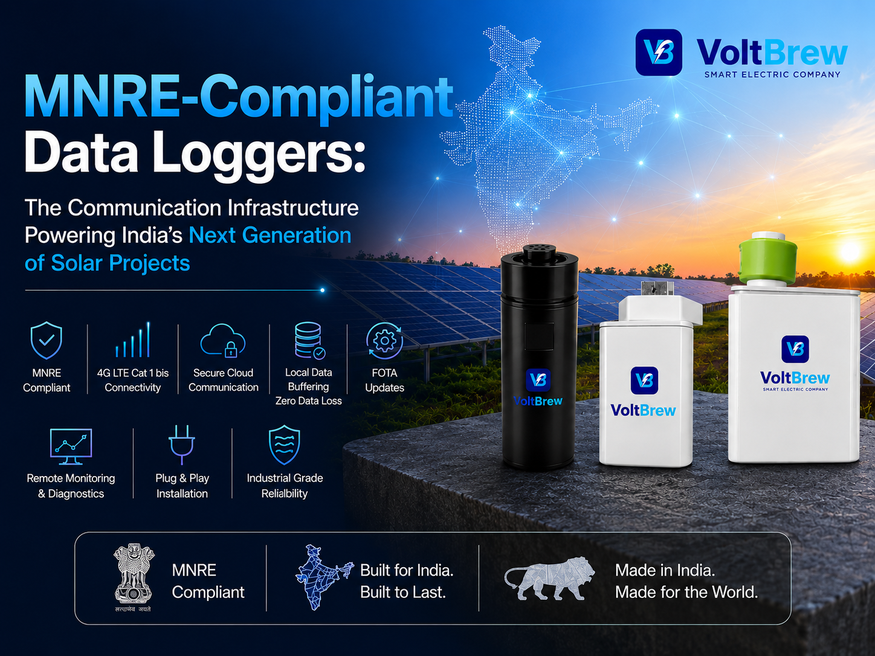
This transformation is redefining the role of communication infrastructure within solar projects. Today, an MNRE-compliant data logger is no longer viewed as a peripheral device—it has become the communication backbone that enables visibility, interoperability, and reliable data exchange across the entire solar ecosystem.
For EPC contractors, inverter OEMs, project developers, utilities, and policymakers, the focus is no longer just on deploying assets. It is about deploying assets that remain connected, compliant, and operational throughout their lifecycle.
Why Communication Infrastructure Is Becoming a Strategic Asset
The modern solar plant is built on three interconnected layers:
- Power Generation – Solar modules and inverters.
- Communication – Data loggers and communication gateways.
- Intelligence – Cloud platforms, analytics, and remote monitoring.
While the first two layers have traditionally received the most attention, the communication layer is now emerging as the critical link that enables digital operations.
A reliable solar data logger enables:
- Continuous data acquisition
- Secure 4G communication
- Remote monitoring and diagnostics
- Cloud connectivity
- Centralized asset management
- Real-time operational insights
- Long-term performance analysis
Without dependable communication infrastructure, operational intelligence becomes fragmented, limiting the value of even the most advanced solar assets.
Compliance Starts Long Before Project Commissioning
One of the biggest misconceptions in the industry is that compliance is something verified only during project commissioning.
In reality, compliance begins much earlier during system design, engineering, and procurement.
As project specifications become increasingly focused on digital monitoring and communication, selecting an MNRE-compliant data logger has become a strategic engineering decision rather than a procurement afterthought.
Organizations that prioritize compliant communication infrastructure early in the project lifecycle often benefit from:
- Faster commissioning
- Simplified system integration
- Reduced implementation risk
- Improved operational visibility
- Easier long-term maintenance
- Greater scalability across multiple projects
Compliance is no longer just about meeting specifications, it is about building infrastructure capable of supporting the future of connected energy.
The Growing Demand for Standardized Monitoring Across States
India’s solar ecosystem is evolving rapidly, and project requirements increasingly emphasize robust communication and monitoring capabilities.
Although technical specifications vary between projects, one trend remains consistent: reliable communication infrastructure is becoming a baseline expectation.
Maharashtra: Building Reliable Communication for Large-Scale Solar Deployments
Solar projects across Maharashtra continue to prioritize centralized monitoring, dependable communication, and scalable digital infrastructure.
For EPCs working on projects aligned with Maharashtra solar tender requirements, choosing a flexible MNRE-compliant data logger can simplify integration while supporting project-specific monitoring expectations.
Andhra Pradesh: Enabling Scalable Monitoring Infrastructure
As utility-scale and distributed solar deployments expand across Andhra Pradesh, communication systems must be capable of supporting continuous data availability and remote asset management.
A robust solar data logger provides the connectivity required for large-scale monitoring while enabling developers and operators to manage geographically distributed assets more efficiently.
Organizations evaluating communication solutions for Andhra Pradesh solar projects increasingly recognize the importance of selecting platforms designed for long-term scalability.
Bihar: Supporting Projects Requiring RS232 and Meter Monitoring
Certain solar projects require communication with both inverters and energy meters.
In such deployments, RS232 communication and meter monitoring become essential components of the monitoring architecture.
A solar data logger with RS232 and meter monitoring enables seamless communication between field devices, simplifying data acquisition while supporting project-specific monitoring requirements.
For EPCs executing projects aligned with Bihar solar tender requirements, selecting communication hardware capable of supporting these interfaces helps reduce deployment complexity and improves operational flexibility.
Why RS232 and Meter Monitoring Continue to Matter
While RS485 remains the industry standard for inverter communication, many utility-scale and government-backed projects continue to require RS232 connectivity for compatible energy meters.
Modern communication infrastructure should therefore support both interfaces without requiring additional gateway devices.
A data logger with meter monitoring offers several operational advantages:
- Simultaneous inverter and meter communication
- Simplified commissioning
- Reduced hardware footprint
- Improved energy accounting
- Better operational visibility
- Centralized monitoring from a single platform
As monitoring requirements become increasingly sophisticated, flexibility in communication architecture becomes a competitive advantage.
Beyond Data Collection: The Evolution of Modern Solar Data Loggers
The term data logger no longer fully reflects the role these devices perform.
Today’s communication gateways are responsible for far more than collecting operational data.
They connect:
- Solar Inverters
- Energy Meters
- Weather Stations
- SCADA Systems
- Cloud Platforms
- Mobile Applications
- Asset Management Systems
This communication layer enables organizations to transition from reactive maintenance toward predictive operations powered by continuous data availability.
In many ways, the MNRE-compliant data logger has evolved into the digital infrastructure layer of the modern solar plant.
Building Future-Ready Solar Assets with VoltBrew
At VoltBrew, we believe communication infrastructure should never be the weakest link in a solar project.
Our MNRE-compliant data loggers are engineered to provide reliable connectivity, seamless integration, and scalable monitoring across diverse solar applications.
Key capabilities include:
- 4G LTE Connectivity
- Multi-brand Inverter Compatibility
- Secure Cloud Communication
- Plug-and-Play Deployment
- RS485 Communication
- RS232 Support
- Integrated Meter Monitoring
- Remote Diagnostics
- Centralized Fleet Monitoring
- Over-the-Air Firmware Updates (FOTA)
Whether supporting rooftop installations, commercial & industrial plants, utility-scale projects, or government-backed deployments, VoltBrew enables organizations to build connected, resilient, and future-ready solar infrastructure.
Final Thoughts: Communication Infrastructure Will Shape the Future of Solar
India’s renewable energy journey is entering a phase where digital infrastructure will become just as important as physical infrastructure.
Solar projects will increasingly be evaluated not only by the electricity they generate, but also by how effectively they communicate, monitor, and manage that generation throughout their operational life.
For EPCs, inverter OEMs, project developers, and policymakers, investing in an MNRE-compliant data logger is no longer simply a technology decision, it is an investment in reliability, compliance, operational excellence, and long-term digital transformation.
As monitoring expectations continue to evolve across projects in Maharashtra, Andhra Pradesh, Bihar, and the rest of India, organizations that prioritize communication infrastructure today will be better prepared for the connected energy ecosystem of tomorrow.